


4
Introduction
Delegated legislation, also known as subordinate or secondary legislation, plays a vital role in modern administrative law. It refers to the law made by an authority other than the legislature, under powers delegated to it by a parent or enabling Act. In India and other democratic countries, Parliament and State Legislatures remain the supreme law-making bodies, but they often delegate certain legislative functions to the executive or administrative authorities.
The growth of delegated legislation is not accidental. It is the direct result of social, economic, political, and administrative developments in a modern welfare State. With expanding governmental responsibilities and technical governance needs, legislatures alone cannot cope with every detail of law-making. Hence, delegated legislation has emerged as a practical necessity. This essay explains the key reasons for the growth of delegated legislation and discusses its classification under administrative law, with reference to Indian legal principles and relevant statutes.
Meaning of Delegated Legislation
Delegated legislation means legislation made by an authority to whom the legislature has delegated power. The legislature lays down the policy, principles, and framework of the law, while the details are filled in by the executive through rules, regulations, bye-laws, notifications, or orders.
In India, delegated legislation derives its validity from the Constitution and the parent statute. Articles 245 and 246 of the Constitution of India vest legislative power in Parliament and State Legislatures, while judicial decisions have recognized that conditional and subordinate legislation is constitutionally permissible, provided essential legislative functions are not delegated.
Reasons for the Growth of Delegated Legislation
Pressure on Legislative Time
One of the primary reasons for the growth of delegated legislation is the pressure on legislative time. Modern legislatures deal with numerous subjects such as finance, defense, health, education, environment, technology, and welfare schemes. It is practically impossible for Parliament to debate every technical detail. Delegated legislation allows legislatures to focus on policy matters while leaving the details to administrative authorities.
Technical and Complex Nature of Modern Governance
Many modern laws deal with technical subjects like environmental protection, telecommunications, banking regulation, taxation, and industrial safety. Legislators may not possess the specialized knowledge required to frame detailed provisions. Delegation enables experts and administrative bodies to make rules based on scientific and technical expertise, ensuring efficiency and accuracy.
Need for Flexibility
Delegated legislation provides flexibility, which is essential in a dynamic society. Parliamentary legislation is rigid and time-consuming to amend, whereas delegated legislation can be modified quickly to meet changing circumstances. This is particularly useful in areas like economic regulation, public health emergencies, and environmental standards.
Emergency Situations
In times of war, epidemics, financial crises, or natural disasters, swift action is necessary. Delegated legislation empowers the executive to take immediate legal action without waiting for lengthy legislative procedures. Laws such as the Disaster Management Act and public health regulations rely heavily on delegated powers to address emergencies effectively.
Welfare State Functions
The transition from a police State to a welfare State has significantly increased governmental functions. The State now regulates labor conditions, minimum wages, consumer protection, social security, and industrial relations. Delegated legislation enables the administration to implement welfare policies efficiently and adjust them according to social needs.
Classification of Delegated Legislation
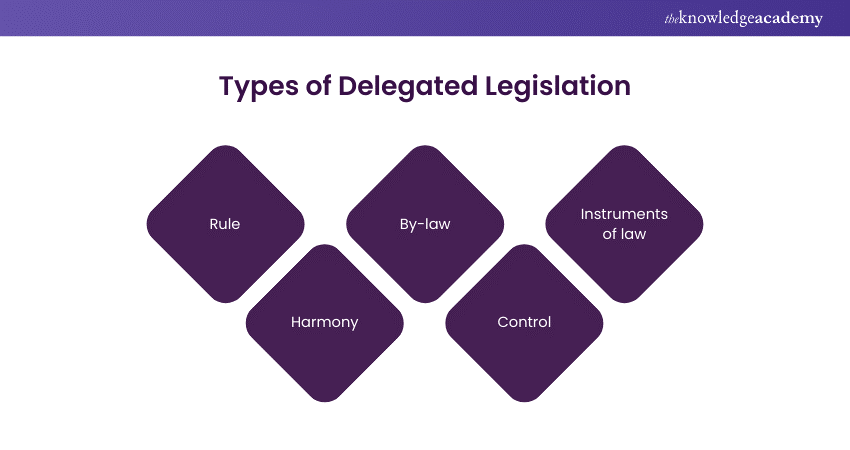
Delegated legislation can be classified on different bases depending on the nature of delegation and the authority involved.
Conditional Legislation
In conditional legislation, the legislature enacts a complete law but leaves its enforcement to depend upon the fulfillment of certain conditions. The executive does not make the law; it merely determines when and where the law will come into force. This type of delegation is constitutionally valid as the policy and principles remain with the legislature.
Subordinate or Rule-Making Legislation
This is the most common form of delegated legislation. Here, the legislature delegates the power to make detailed rules, regulations, and procedures to administrative authorities. These rules must remain within the scope of the parent Act and cannot override its provisions. Examples include service rules, tax rules, and environmental regulations.
Executive Legislation
Executive legislation refers to rules, orders, and notifications issued by the executive under statutory authority. Ministers and government departments exercise such powers to implement laws effectively. This form of legislation is widely used in administrative governance.
Local Legislation
Local authorities such as municipal corporations, panchayats, and development authorities are empowered to make bye-laws for local governance. These bye-laws regulate matters like public health, sanitation, markets, traffic, and building regulations. Local legislation ensures decentralization and efficient local administration.
Autonomous or Quasi-Legislative Bodies
Statutory corporations and regulatory authorities are often given delegated legislative powers. Bodies regulating electricity, telecommunications, insurance, and securities frame regulations within the limits prescribed by the parent statute. Such delegation promotes expert-based governance and independent regulation.
Judicial Control and Safeguards
Although delegated legislation is necessary, it is subject to judicial review. Courts ensure that delegated legislation does not exceed the limits of the parent Act, violate fundamental rights, or involve excessive delegation. The doctrine of ultra vires acts as an important safeguard against misuse of delegated powers.
Conclusion
Delegated legislation has become an indispensable part of modern administrative law. Its growth is driven by legislative overload, technical complexity, the need for flexibility, emergency governance, and the welfare role of the State. At the same time, its classification shows how legislative powers are distributed among different authorities to ensure efficient administration. When exercised within constitutional and statutory limits, delegated legislation strengthens governance while preserving legislative supremacy and the rule of law.
Mnemonic to Remember the Reasons and Classification
“PLEASE WELD RULES”
P – Pressure on legislature
L – Legislative time shortage
E – Expertise requirement
A – Administrative flexibility
S – State welfare role
E – Emergency needs
W – Welfare State
L – Local legislation
D – Delegated rule-making
R – Regulations
U – Uniform application
L – Local bye-laws
E – Executive orders
S – Subordinate legislation
About Lawgnan
If you are preparing for law exams, judicial services, or academic writing in administrative law, understanding delegated legislation is essential for scoring well and developing conceptual clarity. Visit lawgana.in for in-depth notes, exam-oriented answers, case law explanations, and simplified legal content designed for students and professionals. Stay updated with quality legal resources, practical insights, and structured explanations that help you master complex topics with ease. Start learning smarter and strengthen your legal foundation today by exploring expert-curated content on lawgana.in.