Foundation of Buyer–Seller Relationship
In commercial transactions, especially in the sale of goods, the law provides certain protections to both the buyer and the seller to ensure fairness and accountability. When a buyer purchases goods, he expects them to match the description, purpose, and quality promised by the seller. The Sale of Goods Act, 1930, which governs such contracts in India, introduces two important legal concepts to safeguard buyers’ rights — Conditions and Warranties.
These terms determine the nature of contractual obligations and the remedies available in case of breach. Understanding the difference between a condition and a warranty is essential because it affects whether the buyer can repudiate the contract or only claim damages. This essay defines these two terms under the Sale of Goods Act, 1930, explains their key distinctions, and provides practical examples to illustrate their significance.
Legal Definition of “Condition” – Section 12(2) of the Sale of Goods Act, 1930
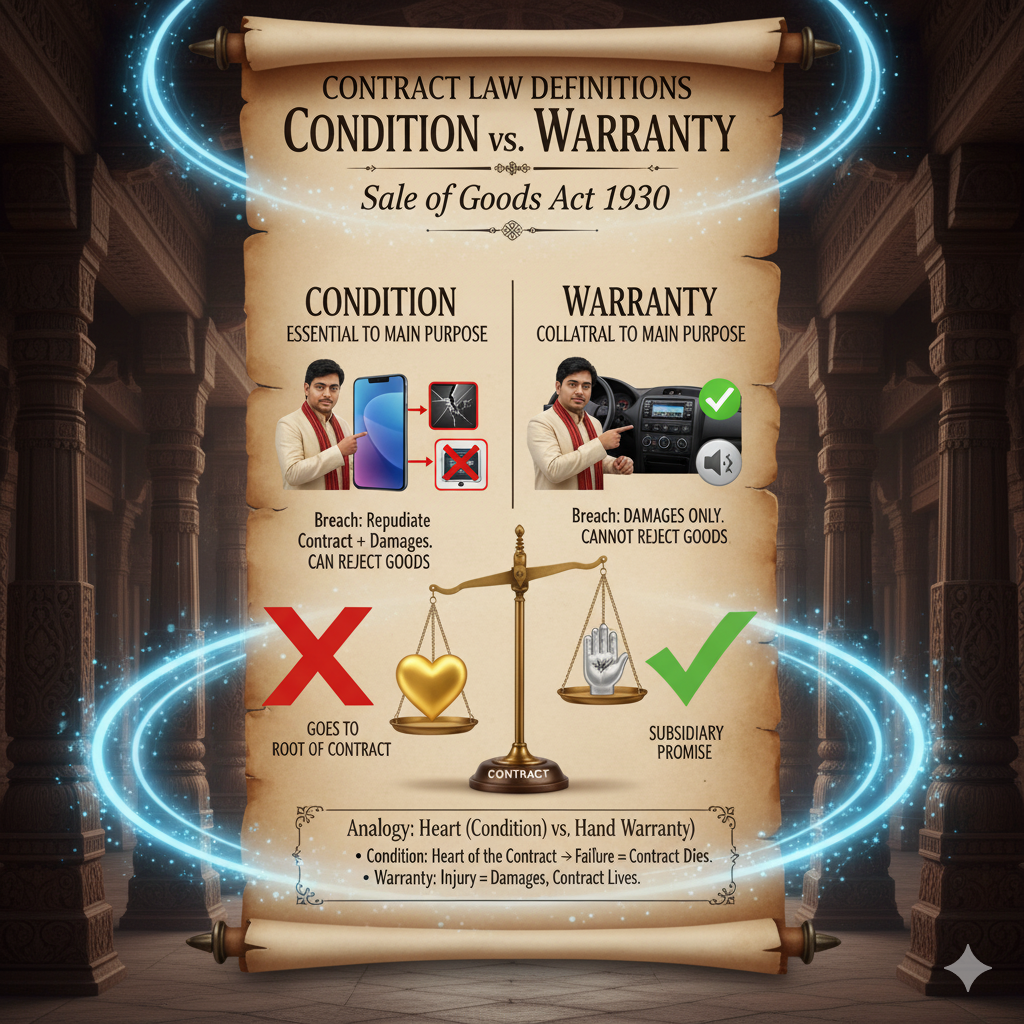
A Condition, as defined under Section 12(2) of the Sale of Goods Act, 1930, is a stipulation essential to the main purpose of the contract, the breach of which gives the aggrieved party the right to repudiate (reject) the contract.
In simpler words, a condition forms the core or root of the agreement between the buyer and seller. It directly affects the buyer’s decision to enter into the contract. If a condition is breached, the buyer is entitled to refuse the goods, cancel the contract, and claim damages.
For example, if a buyer orders a new “Honda City 2024 model” and the seller delivers a “Honda Amaze 2022 model,” the buyer can reject the goods because the condition regarding the identity of the goods has been violated.
Key Features of a Condition:
- It is fundamental to the contract.
- Its breach allows repudiation of the contract.
- It affects the main purpose of the agreement.
- Breach of condition can sometimes be treated as a breach of warranty, if the buyer chooses to accept the goods.
Legal Definition of “Warranty” – Section 12(3) of the Sale of Goods Act, 1930
According to Section 12(3) of the Sale of Goods Act, 1930, a Warranty is a stipulation collateral to the main purpose of the contract, the breach of which gives rise to a claim for damages but not a right to reject the goods or repudiate the contract.
A warranty, therefore, is a subsidiary promise or a secondary term in the contract. Its breach does not go to the root of the agreement but only affects its performance. The buyer cannot cancel the contract but can claim compensation for any loss suffered due to the breach.
For example, if a buyer purchases a new smartphone that works well but the company fails to provide the promised earphones, this is a breach of warranty, not a condition. The buyer can claim damages but cannot return the phone.
Key Features of a Warranty:
- It is collateral (secondary) to the main purpose.
- Breach gives a right to damages only, not contract cancellation.
- The buyer must accept the goods but can claim compensation.
- Often implied by the nature of trade or custom.
Distinction Between Condition and Warranty
The distinction between a condition and a warranty is vital because it determines the remedy available to the buyer in case of a breach. The following table clearly illustrates their major differences:
| Basis of Difference | Condition | Warranty |
|---|---|---|
| Definition | A stipulation essential to the main purpose of the contract (Sec. 12(2)). | A stipulation collateral to the main purpose of the contract (Sec. 12(3)). |
| Nature | Fundamental or core term of the contract. | Subsidiary or secondary term of the contract. |
| Effect of Breach | Buyer can repudiate the contract and claim damages. | Buyer can only claim damages; cannot repudiate the contract. |
| Right to Reject Goods | Yes, buyer can reject the goods. | No, buyer must accept the goods. |
| Conversion Possibility | Breach of condition may be treated as breach of warranty (Sec. 13). | Breach of warranty cannot be treated as breach of condition. |
| Example | Car advertised as “new” turns out to be “used.” | Car delivered on time but without a spare tyre as promised. |
Legal Provision Supporting the Difference: Section 13 of the Sale of Goods Act, 1930
Section 13 provides that if a buyer chooses to waive a condition or accept goods despite the breach, then the breach of condition shall be treated as a breach of warranty. This means that while conditions are essential, the buyer can still opt to accept the goods and merely claim compensation instead of rejecting them.
Implied Conditions and Warranties (Sections 14–17)
In addition to express terms, the Sale of Goods Act also recognizes implied conditions and warranties that automatically form part of every contract, unless excluded by the agreement.
Implied Conditions:
- Condition as to Title (Sec. 14(a)) – The seller has the right to sell the goods.
- Condition as to Description (Sec. 15) – Goods must correspond with the description.
- Condition as to Quality or Fitness (Sec. 16) – Goods must be fit for the buyer’s stated purpose.
- Condition as to Merchantable Quality (Sec. 16(2)) – Goods must be saleable and fit for ordinary use.
- Condition by Sample (Sec. 17) – Goods must match the sample shown.
Implied Warranties:
- Warranty of Quiet Possession (Sec. 14(b)) – Buyer’s use of goods should not be disturbed.
- Warranty Against Encumbrances (Sec. 14(c)) – Goods should be free from third-party claims.
- Warranty of Quality or Fitness (Sec. 16(1)) – Arises by custom of trade or usage.
These provisions ensure consumer protection and commercial fairness even when not expressly mentioned in a contract.
Judicial Interpretation
In Wallis v. Pratt (1910), the court observed that whether a term is a condition or warranty depends on the intention of the parties and the importance of the stipulation to the contract.
Similarly, in Baldry v. Marshall (1925), the buyer wanted a car suitable for long-distance touring. The seller sold him a car that was unsuitable for that purpose. The court held that the term regarding fitness was a condition, not a warranty, allowing the buyer to reject the goods.
These cases demonstrate that courts assess the purpose, intention, and significance of the term to determine whether it is a condition or a warranty.
Real-Life Example
Suppose Ravi buys a “Samsung Refrigerator – 400L Inverter Model” from a dealer. If the refrigerator delivered is not the model Ravi ordered, it is a breach of condition, as it goes to the root of the contract. Ravi can reject the product and demand a refund.
However, if the refrigerator is the correct model but the dealer fails to provide the promised free installation service, this is a breach of warranty. Ravi cannot reject the refrigerator but can claim damages for the inconvenience or cost of installation.
This example clearly shows how the nature of the breach determines the buyer’s legal remedy.
Mnemonic to Remember: “COW DARE”
To remember the difference between Condition and Warranty, use the mnemonic COW DARE:
- C – Core term (Condition is essential)
- O – Optional right to reject (Buyer can repudiate for breach)
- W – Warranty is secondary
- D – Damages only for warranty breach
- A – Affects purpose of contract (Condition)
- R – Right to reject (Condition only)
- E – Express or implied terms under law
Mnemonic Sentence:
“COW DARE buyers to know their rights.”
It reminds you that Condition relates to the core of the contract and allows repudiation, while Warranty offers only damages for breach.
About lawgnan:
To master the Difference Between Condition and Warranty under the Sale of Goods Act, 1930, visit Lawgnan.in — your go-to platform for simplified and exam-oriented law notes. Understand Sections 12 to 17 in detail with real-life examples, case laws, and easy mnemonics like “COW DARE.” Whether you’re an LLB student, law aspirant, or legal professional, Lawgnan helps you grasp every legal concept clearly and confidently. Get access to well-structured study materials, previous question papers, and expert guides that make complex laws easy to remember. Strengthen your legal foundation and ace your exams with Lawgnan.in today!