Introduction
The Doctrine of Election is an important equitable principle recognized under the Transfer of Property Act, 1882, which ensures fairness when a person is put to a choice between two inconsistent rights. The doctrine prevents a person from simultaneously accepting benefits under an instrument while rejecting its burdens. In property law, it commonly applies where a transferor attempts to dispose of property that does not belong to him, but also confers a benefit on the true owner through the same instrument.
The doctrine is based on the maxim “He who accepts the benefit must bear the burden.” Indian courts have consistently upheld this principle to maintain justice, equity, and good conscience.
Meaning of Doctrine of Election
The Doctrine of Election means that when two inconsistent or alternative rights are available under a single instrument, the person must choose (elect) one and cannot enjoy both. If a person accepts the benefit under an instrument, he is bound to give effect to the whole instrument, even if it means surrendering some other right.
This doctrine is codified under Section 35 of the Transfer of Property Act, 1882.
Statutory Basis – Section 35, Transfer of Property Act, 1882
Section 35 provides that:
Where a person professes to transfer property which he has no right to transfer, and as part of the same transaction confers any benefit on the owner of that property, such owner must elect either to confirm such transfer or to dissent from it.
If the owner elects to confirm the transfer, he must give up the benefit. If he dissents, the transfer becomes void, and the benefit must be restored.
Essential Conditions for Doctrine of Election
For the doctrine to apply, the following conditions must be satisfied:
- Two Inconsistent Rights
There must be two rights that cannot exist together. - Single Instrument
Both the transfer and the benefit must arise from the same document. - Transferor Has No Authority
The transferor must have no right to transfer the property in question. - Benefit to the True Owner
The instrument must confer a benefit on the real owner. - Knowledge and Free Choice
The person electing must have full knowledge of the circumstances and freedom to choose.
Modes of Election
Election may be made in two ways:
1. Express Election
Where the person clearly states his intention to accept or reject the benefit.
2. Implied Election
Where conduct shows acceptance of benefit, such as enjoyment of property, receipt of income, or silence over a long period.
Exceptions to the Doctrine of Election
The doctrine does not apply in the following situations:
- Where the benefit is conferred independently of the transfer
- Where the person electing is a minor or legally incapable
- Where election is made under fraud, coercion, or misrepresentation
- Where the benefit is compulsory or statutory
Effect of Election
- If benefit is accepted → transfer must be confirmed
- If benefit is rejected → transfer fails, and compensation may be payable
If a person does not elect within a reasonable time, the court may presume an election based on conduct.
Decided Case Laws on Doctrine of Election
1. Cooper v. Cooper (1874)
This landmark English case laid down the foundation of the doctrine. The court held that a person who takes benefit under an instrument must also accept its burdens.
Principle: Acceptance of benefit implies acceptance of obligation.
2. Kishen Lal v. Bansidhar (AIR 1924 PC 201)
The Privy Council held that where a benefit is accepted with full knowledge, election is complete and irrevocable.
Principle: Knowledge is essential for valid election.
3. Raghunath Prasad v. Deputy Commissioner (AIR 1929 PC 283)
The court ruled that election can be inferred from conduct, even without express declaration.
Principle: Implied election is valid in law.
4. Nirmala Bala Ghose v. Balai Chand Ghose (AIR 1965 SC 1874)
The Supreme Court clarified that election must be voluntary and with full understanding of rights.
Principle: Free consent is mandatory for election.
5. C. Beepathuma v. Velasari Shankaranarayana (AIR 1965 SC 241)
The Supreme Court emphasized that one cannot approbate and reprobate under the same instrument.
Principle: One instrument, one consistent choice.
Doctrine of Election and Wills
The doctrine frequently applies in wills where a testator bequeaths property not belonging to him while giving a benefit to the real owner. In such cases, the beneficiary must choose between retaining his own property or accepting the benefit under the will.
Importance of Doctrine of Election
- Prevents unjust enrichment
- Ensures consistency in legal transactions
- Protects rights of true owners
- Upholds equitable principles
- Reduces misuse of legal instruments
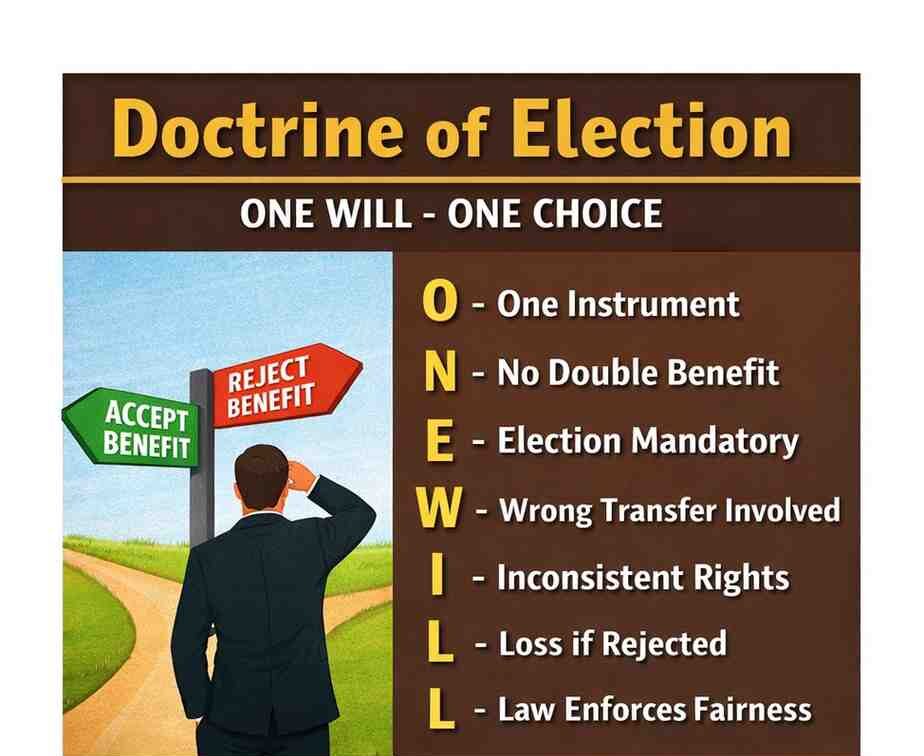
Mnemonic to Remember Doctrine of Election
“ONE WILL – ONE CHOICE”
O – One instrument
N – No double benefit
E – Election mandatory
W – Wrong transfer involved
I – Inconsistent rights
L – Loss of benefit if rejected
L – Law enforces fairness
About Lawgnan
Understanding doctrines like the Doctrine of Election is essential for mastering property law, especially for law students, judiciary aspirants, and legal professionals. At lawgnan.in, we simplify complex legal concepts with case laws, exam-oriented explanations, and practical illustrations. Whether you are preparing for LLB exams, judiciary services, or competitive law entrances, our expert-crafted content helps you learn faster and retain longer. Visit lawgnan.in today to explore high-quality legal notes, case law summaries, and concept clarity articles designed exclusively for Indian law students and professionals.