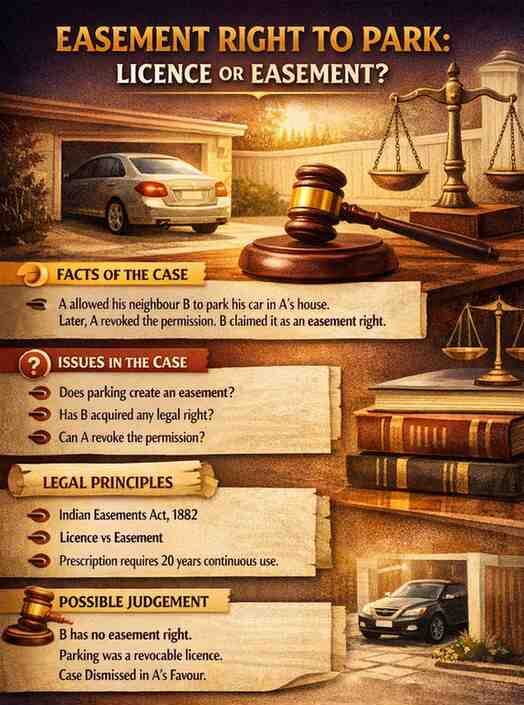
1. Facts of the Case
A is the owner of a residential house. Out of goodwill and neighbourly relations, A permitted his neighbour B to park his car within A’s house premises. This permission was informal, without any written agreement or consideration. After some time, due to personal inconvenience, A withdrew the permission and refused to allow B to park his car anymore. Aggrieved by this refusal, B claimed that he had acquired an easementary right to park his car in A’s property and alleged that A could not legally revoke such right.
2. Issues in the Case
- Whether allowing parking of a car amounts to the creation of an easement under Indian law.
- Whether B has acquired any legal or prescriptive easementary right over A’s property.
- Whether A is legally entitled to revoke the permission granted to B.
3. Legal Principles Covered to Support Case Proceedings and Judgements
Under Section 4 of the Indian Easements Act, 1882, an easement is a right possessed by the owner of a dominant heritage over a servient heritage for the beneficial enjoyment of his property. Parking a vehicle does not benefit B’s land but only provides personal convenience.
Further, Section 52 of the Indian Easements Act, 1882 defines a licence, which is permission to do something on another’s property without creating any interest or right. The permission granted by A was purely personal, temporary, and revocable.
An easement by prescription under Section 15 requires continuous, open, and uninterrupted enjoyment as of right for 20 years. In the present case, the permission was neither hostile nor continuous for the statutory period. Courts have consistently held that parking permission is a revocable licence, not an easement.
4. Possible Judgement
The court is likely to hold that B has not acquired any easementary right to park his car in A’s house. The act of parking was a mere licence, revocable at the will of the owner. Since no legal easement was created, A is well within his rights to withdraw the permission. Therefore, B’s claim fails, and the suit would be dismissed in favour of A.
About Lawgnan
Understanding the difference between an easement and a licence is crucial in resolving property disputes like parking rights, pathways, and usage permissions. Many disputes arise due to misconceptions about long-term usage creating permanent rights. To explore more simplified explanations of property law, easements, licences, and real-life legal case analysis under Indian law, visit lawgnan.in. Stay informed with accurate legal insights, student-friendly explanations, and exam-oriented content. Whether you are a law student, legal aspirant, or property owner, Lawgana helps you make informed legal decisions confidently.