Understanding the Need for a “Pure” Theory
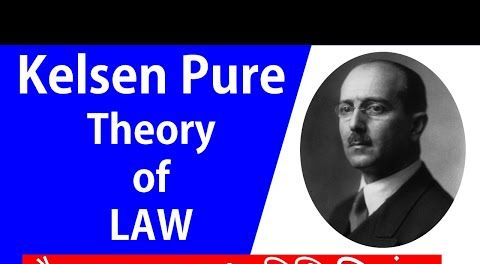
Hans Kelsen’s Pure Theory of Law is one of the most influential and debated contributions to jurisprudence. Developed in the early 20th century, Kelsen sought to create a scientific, objective, and value-free theory of law. At a time when law was often mixed with morality, politics, sociology, and psychology, Kelsen argued that such mixing diluted legal science. His central aim was to separate law from non-legal elements and study it as a normative system. According to Kelsen, law should be understood purely as law, not as a tool of morality or a product of social forces. This radical approach reshaped modern legal positivism and continues to influence constitutional theory and judicial reasoning across the world.
Meaning of the Pure Theory of Law
The Pure Theory of Law explains law as a system of norms rather than commands, moral ideals, or social facts. A norm is a rule that prescribes how people ought to behave, not how they actually behave. Kelsen rejected the idea that law derives its validity from justice, ethics, or divine authority. Instead, he emphasized that legal validity flows from other legal norms, arranged in a hierarchical order. Law, for Kelsen, is not concerned with what is good or bad, but only with what is legally valid or invalid. This approach makes the theory “pure” because it removes external influences and focuses strictly on legal structure.
Law as a Normative System
A core concept in Kelsen’s theory is that law is a normative system, meaning it consists of “ought” statements rather than “is” statements. Unlike sociology, which studies how people behave, jurisprudence studies the rules prescribing behavior. For example, criminal law does not merely describe crimes; it prescribes sanctions for unlawful conduct. This normative character distinguishes law from natural sciences. Kelsen insisted that legal science must confine itself to the study of norms and their relationships, not the moral worth or social impact of those norms.
Separation of Law and Morality
One of the most controversial aspects of the Pure Theory of Law is its strict separation of law and morality. Kelsen argued that moral values are subjective and vary across societies, whereas law must be objective and universally applicable within a legal system. A law does not cease to be law simply because it is unjust or immoral. For example, discriminatory laws may be morally wrong, but they remain legally valid until repealed or struck down by a competent authority. This view strongly influenced legal positivism and contrasts sharply with natural law theories, which link law to moral principles.
Hierarchy of Norms
Kelsen introduced the idea that legal norms are arranged in a hierarchical structure, where each lower norm derives its validity from a higher norm. At the bottom are individual legal acts such as court judgments and administrative orders. Above them are statutes, then constitutional provisions. This hierarchy ensures coherence and unity in the legal system. A law is valid not because it is just, but because it has been created according to the procedure prescribed by a higher norm. This idea explains why unconstitutional laws can be invalidated by constitutional courts.
The Concept of Grundnorm
At the top of Kelsen’s hierarchy lies the famous concept of Grundnorm or “basic norm.” The Grundnorm is the foundational norm that gives validity to the entire legal system. It is not enacted by any authority; rather, it is presupposed. In a democratic system, the Grundnorm may be understood as: “The Constitution ought to be obeyed.” All laws derive their validity from the Constitution, and the Constitution derives its authority from the Grundnorm. This concept helps avoid infinite regression when asking why a law is valid. The Grundnorm is thus a necessary assumption for understanding legal validity.
The State and Law: Identity Theory
Kelsen rejected the traditional view that the State creates law. Instead, he proposed the identity theory, arguing that the State is the legal order itself. According to him, the State has no existence apart from the legal system. Acts of the State are valid only because they are authorized by legal norms. This idea removed metaphysical notions of sovereignty and replaced them with a strictly legal explanation. In this sense, Kelsen’s theory demystifies political power and subjects it entirely to legal norms.
Pure Theory and Constitutional Law
Kelsen’s theory had a profound impact on constitutional law, especially the concept of constitutional supremacy. His ideas influenced the establishment of constitutional courts, particularly in Austria. The power of courts to review legislation and strike down unconstitutional laws fits perfectly with Kelsen’s hierarchical model. In India, the supremacy of the Constitution and judicial review under Articles 13, 32, and 226 of the Constitution of India reflect Kelsenian thinking, even though Indian jurisprudence also accommodates moral and social considerations
Legal Responsibility and Sanctions
Kelsen viewed legal responsibility as a normative consequence of violating legal norms. A wrongful act does not automatically produce punishment; rather, punishment follows because a legal norm prescribes a sanction. This approach shifts focus from moral blameworthiness to legal consequences. Even criminal liability, in Kelsen’s view, is a matter of legal norms prescribing sanctions, not moral guilt. This perspective further reinforces the purity and objectivity of legal analysis.
Criticism of Kelsen’s Pure Theory
Despite its influence, the Pure Theory of Law has faced serious criticism. Critics argue that complete separation of law and morality is unrealistic, especially in constitutional democracies where rights and justice are central. Others contend that the concept of Grundnorm is hypothetical and lacks empirical foundation. Sociological jurists criticize Kelsen for ignoring social realities, while natural law thinkers argue that law without moral content is incomplete. Nevertheless, even critics acknowledge that Kelsen provided an exceptionally rigorous framework for understanding legal systems.
Relevance in Modern Jurisprudence
In contemporary legal systems, Kelsen’s theory remains highly relevant. Concepts like constitutional supremacy, legal validity, judicial review, and normative hierarchy owe much to his ideas. While modern jurisprudence often blends law with morality and social justice, the analytical clarity offered by the Pure Theory continues to be invaluable for legal scholars, judges, and students. It provides a strong foundation for understanding how legal systems function internally.
Mnemonic to Remember Kelsen’s Pure Theory
“PURE NORM LAW”
P – Pure science of law
U – Unity of legal system
R – Rejection of morality
E – Effectiveness of norms
NORM – Law as norms
LAW – Legal validity from Grundnorm
About lawgnan
Kelsen’s Pure Theory of Law is a core jurisprudence topic frequently asked in LLB, LLM, and judicial service examinations. A clear understanding of concepts like Grundnorm, normative hierarchy, and separation of law and morality can significantly improve answer quality. For more SEO-optimized, exam-oriented, and easy-to-understand jurisprudence articles, visit lawgana.in. The platform offers well-structured legal notes, mnemonics, case references, and simplified explanations tailored for Indian law students and aspirants. Start learning smarter and strengthen your jurisprudence foundation today with lawgana.in.