Explain the Evolution and Development of the Law of the Sea
The law of the sea governs maritime conduct. It outlines the rights and responsibilities of nations in ocean use. Over centuries, this legal area grew from vague customs to detailed international law. Its evolution mirrors humanity’s expanding interest in marine resources, security, and trade.
Ancient Beginnings
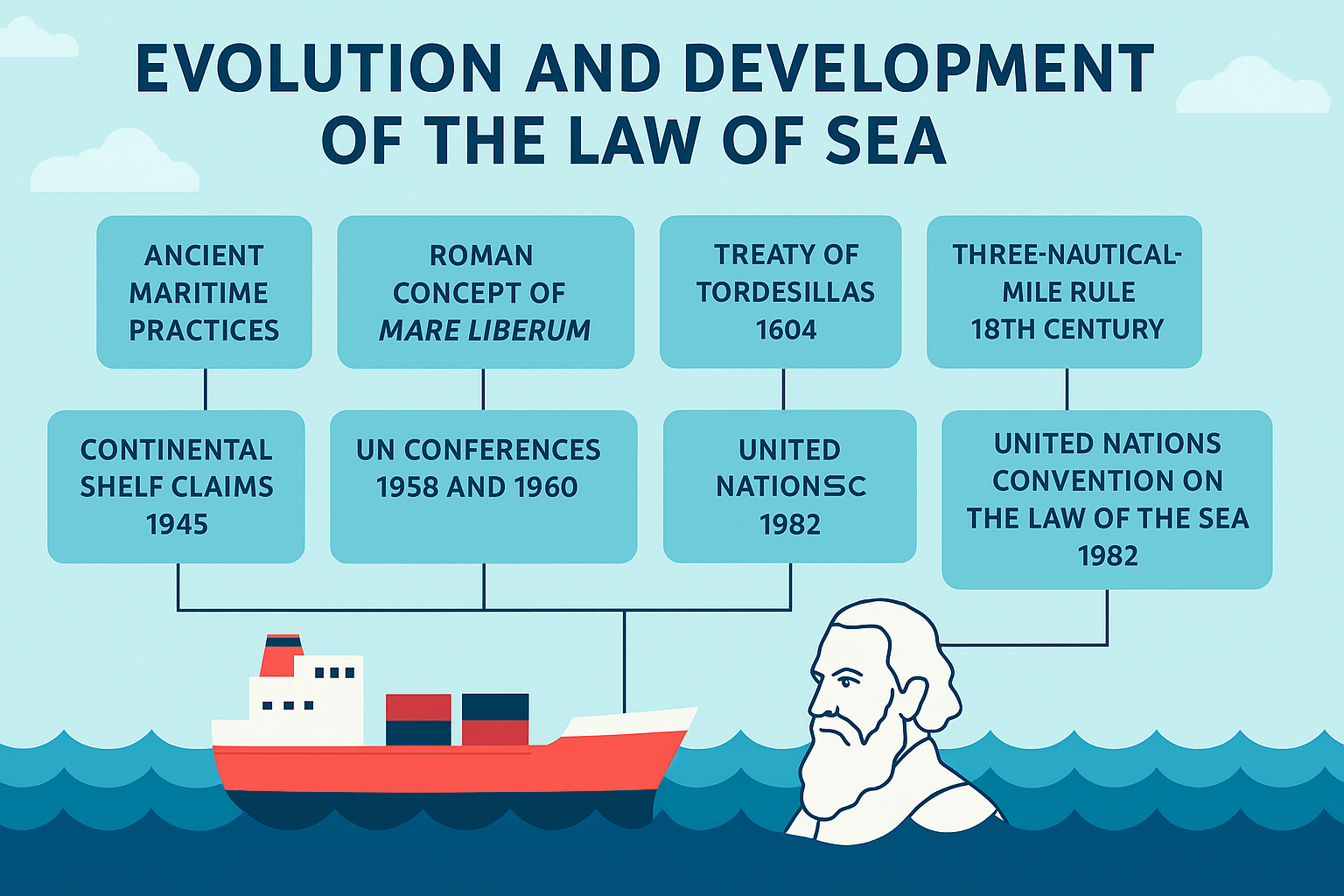
Maritime practices trace back to early civilizations. Egyptians, Greeks, and Phoenicians engaged in sea trade and naval battles. However, no formal global rule existed. Instead, local customs guided navigation and ownership. Coastal empires often claimed control over nearby waters, but such claims lacked universal acceptance.
Roman Influence
The Romans introduced clearer legal ideas. They believed in mare liberum—the concept of free seas. This principle allowed open access to oceans for navigation and commerce. Though not codified, it laid a moral and philosophical foundation. The idea opposed monopolies over seas and promoted shared use.
Rise of Territorial Claims
During the 15th and 16th centuries, maritime powers like Spain and Portugal began claiming vast sea territories. These claims followed their exploration conquests. The 1494 Treaty of Tordesillas divided the ocean between the two. This move sparked resistance from other nations. The need for balanced regulation became clear.
Grotius and Mare Liberum
Dutch scholar Hugo Grotius challenged exclusive claims. In 1609, he wrote Mare Liberum (The Free Sea). His work argued that no nation could own the sea. The keypharse helped assert maritime freedom, especially for Dutch trade interests. Grotius’ views later influenced international norms and triggered debates on sea ownership.
Emergence of Territorial Waters
By the 18th century, countries accepted a limited territorial sea zone. Cornelius van Bynkershoek proposed a three-nautical-mile rule. This distance reflected the range of coastal cannons. It balanced security needs with free navigation. Gradually, this idea gained global recognition, forming the early structure of modern maritime law.
Twentieth Century Expansion
With technology advancing, countries sought more control over marine zones. Oil, gas, and fishing interests drove expansion. In 1945, the U.S. claimed jurisdiction over its continental shelf for resource exploration. Other nations followed. The keypharse now expanded to address seabed rights and environmental protection.
The Role of the United Nations
To resolve growing disputes, the UN convened conferences. The first two, in 1958 and 1960, tried to standardize sea laws. They brought partial success. The real breakthrough came in 1982 with the United Nations Convention on the Law of the Sea (UNCLOS). This treaty marked a turning point.
UNCLOS: A New Maritime Order
UNCLOS created a legal framework for nearly every sea-related issue. It defined maritime zones such as:
- Territorial Sea (12 nautical miles)
- Contiguous Zone (24 nautical miles)
- Exclusive Economic Zone (200 nautical miles)
- Continental Shelf rights
It also addressed deep-sea mining, marine pollution, and navigation freedom. The keypharse became integral in managing peaceful sea usage and resolving maritime conflicts.
Modern Developments
Today, over 160 countries have ratified UNCLOS. However, new challenges continue to shape the law. Climate change, rising sea levels, and melting ice caps create boundary disputes. Maritime piracy, underwater cables, and marine biodiversity issues need updated rules. Nations and organizations must adapt while upholding core principles.