
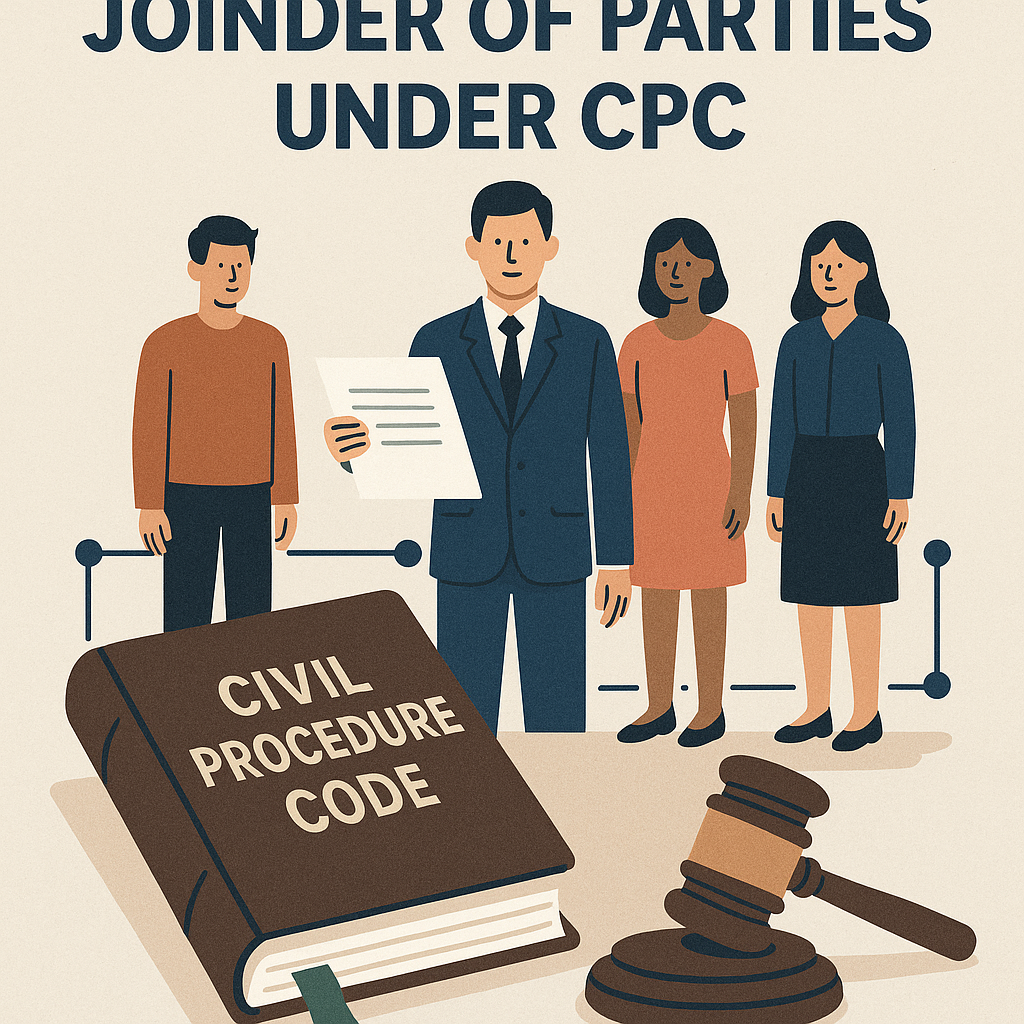
What is Joinder of Defendants?
In legal terms, joinder of defendants refers to the inclusion of two or more defendants in a single suit when:
- The matter involves common legal or factual issues, or
- The rights or liabilities of the defendants arise from the same transaction or series of transactions.
This provision helps the court handle the dispute collectively rather than through separate and repetitive proceedings.
Legal Provision Under Indian Law
The Code of Civil Procedure, 1908, under Order I Rule 3, governs the rules related to the joinder of defendants. According to this rule, all persons against whom the right to relief arises out of the same act or series of acts may be joined as defendants in one suit.
Conditions for Joinder of Defendants
To join multiple defendants in one suit, the following conditions must be satisfied:
1. Common Right to Relief
The plaintiff must claim relief against all defendants on a common ground, such as a shared liability or breach of duty.
2. Same Transaction or Series of Transactions
The action taken by each defendant must relate to the same incident or connected set of facts.
3. Common Question of Law or Fact
The dispute must involve common legal or factual issues, such as the interpretation of a contract or breach of a common obligation.
Purpose and Importance of Joinder
- Avoids Multiplicity of Suits: The court handles all disputes in one proceeding, saving time and resources.
- Prevents Conflicting Judgments: A single trial ensures uniformity in the final decision.
- Enhances Judicial Economy: It promotes faster disposal of cases with interrelated claims.
- Promotes Fairness: All parties are heard in a common platform, ensuring balanced justice.
Relevant Case Law
In Ramesh Hirachand Kundanmal v. Municipal Corporation of Greater Bombay (1992 AIR 2056), the Supreme Court held that the joinder of necessary or proper parties is essential for the complete and effective adjudication of the dispute.
Similarly, in Prem Lala Nahata v. Chandi Prasad Sikaria (2007), the court reiterated that joinder should not cause delay or prejudice to any party, but it must serve the interest of justice.
Who is a Necessary and Proper Defendant?
- Necessary Party: A person without whom the court cannot pass an effective decree.
- Proper Party: A person who may not be essential but whose presence aids in resolving the matter completely.
Joinder of defendants applies more strongly when necessary parties are involved.
Can the Court Reject Improper Joinder?
Yes. Under Order I Rule 10 of the CPC, the court has discretion to strike out any party improperly joined or add a necessary one. This ensures the suit remains focused and just.