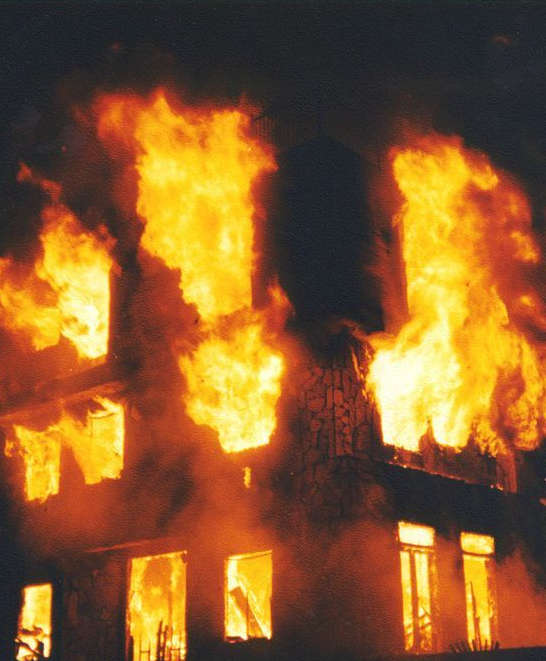
Facts of the Case
- A planned to commit robbery in a house during the night.
- To facilitate the robbery or to frighten the occupants, A intentionally set fire to the house.
- The fire spread uncontrollably, and one person inside the house died due to the fire.
- A is caught and prosecuted for causing death and committing robbery.
- The issue is whether A is liable only for robbery or also for the death of the person.
Issues in the Case
- Whether A is liable for the offence of robbery?
- Whether A is liable for the death of the person caused by the fire he intentionally set?
- Whether the death amounts to murder or culpable homicide under the IPC?
- Whether the principle of constructive liability (Section 301 or 300/302 IPC) applies?
- Whether the act of setting fire shows intention/knowledge sufficient to attract Section 300 IPC?
Legal Principles, Provisions & Case Law
A. Liability for Robbery – Sections 390 & 392 IPC
- Robbery involves theft + violence or fear of violence.
- Entry at night, setting fire, and using fear constitute elements sufficient for robbery.
Therefore, A is liable for robbery.
B. Liability for Causing Fire – Section 436 IPC
Section 436 IPC states:
“Whoever commits mischief by fire or explosive substance with intent to destroy a house… shall be punished with imprisonment for life or imprisonment up to 10 years and fine.”
A intentionally set fire to the house → clear offence under Section 436 IPC.
C. Liability for Death — Murder or Culpable Homicide
The key question:
Does intentionally setting fire to an occupied house constitute murder if a person dies?
Relevant Sections:
Section 300 IPC – Murder (Clauses 4thly)
A person commits murder if they do an act:
“so imminently dangerous that it must, in all probability, cause death… and commits such act without any excuse for incurring the risk.”
- Setting fire to an inhabited house at night is an act that is imminently dangerous.
- A knew people would be inside and death was a highly probable consequence.
Thus, the act falls under Section 300 – 4th clause.
The punishment is under Section 302 IPC – murder (death or life imprisonment).
D. Doctrine of Transferred Malice / Constructive Liability
Under Section 301 IPC, if A commits an act meant to kill one person but kills another, liability remains the same.
Even if A did not intend to kill this person, he intended an act dangerous to human life. Thus, the resultant death attracts murder liability.
E. Case Law Support
- State of Madhya Pradesh v. Ram Prasad (1968 SC)
Setting fire to a house knowing people are inside attracts 302 IPC due to knowledge of likely death. - Virsa Singh v. State of Punjab (1958 SC)
Explains that intention + dangerous act leading to death amounts to murder. - Om Prakash v. State of Punjab (1961)
Fire deaths in occupied buildings → murder due to imminently dangerous act.
Possible Judgment
(A) On the Charge of Robbery
A is guilty of robbery under Sections 390 & 392 IPC.
(B) On the Charge of Causing Fire
A is guilty under Section 436 IPC, as he intentionally set fire to a dwelling house.
(C) On the Charge of Causing Death
A is also liable for murder (Section 302 IPC) because:
- The act of setting fire to an occupied house is extremely dangerous.
- A knew people were likely to be inside during the night.
- Death was a probable outcome of his deliberate act.
Even if A only intended robbery, the law holds him liable for the natural and foreseeable consequences of his act.
Final Judicial Conclusion
A is liable for both offences:
- Robbery – Sections 390/392 IPC
- Murder – Section 302 IPC (read with Section 300, Clause 4thly)
- Mischief by fire – Section 436 IPC
Thus, A will face life imprisonment or death penalty for murder, along with additional punishment for robbery and arson.
About lawgnan
To understand how Indian criminal law treats offences involving robbery, arson, and death, explore more detailed, exam-ready explanations on Lawgana.in. Our platform provides clear interpretations of IPC Sections 302, 392, 436, and doctrines like constructive liability and transferred malice. Whether you’re a law student, judiciary aspirant, or legal researcher, Lawgana.in offers structured case analyses, landmark judgments, and easy-to-remember notes to strengthen your legal understanding. Visit Lawgana.in to access simplified, well-organised criminal law content, gain clarity on complex legal issues, and enhance your conceptual mastery for exams and practice.